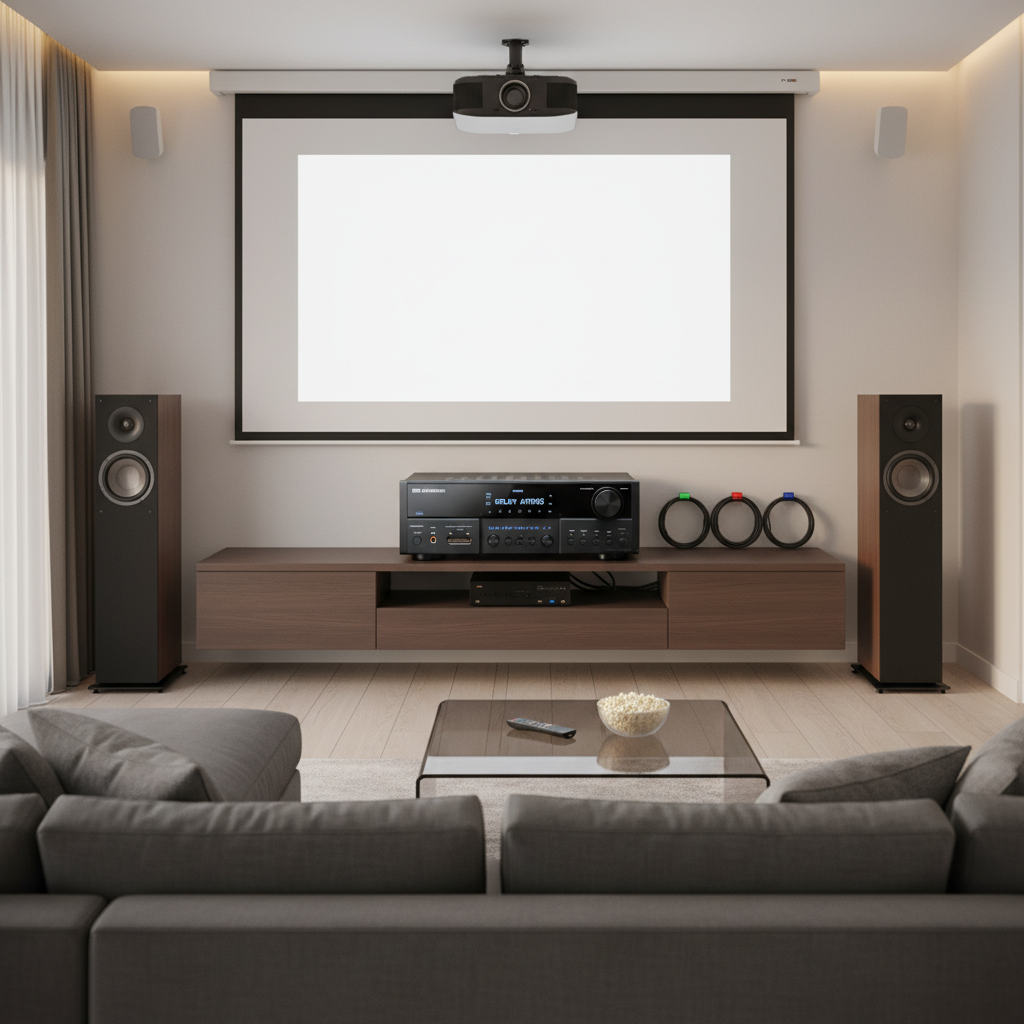
Stepping into the world of home cinema with a projector offers an unparalleled immersive experience, transforming your living space into a private movie theater or an expansive gaming arena. But a stunning visual display is only half the picture; truly captivating home entertainment demands equally powerful and precise audio. This is where the digital receiver, often referred to as an AV receiver or home theater receiver, becomes the central nervous system of your setup, orchestrating both sound and video to create an unforgettable cinematic journey.
As a seasoned technician with over a decade of experience in digital receiving equipment, I’ve seen these devices evolve from basic audio processors to sophisticated hubs capable of handling the most demanding multimedia. In this guide, we’ll explore why a digital receiver is indispensable for your projector setup, delve into the crucial features you need to consider for 2026, highlight some of the top models currently available, and provide practical advice for seamless integration and optimization.
What is a Digital Receiver and Why is it Essential for Projector Setups?
At its core, a digital receiver is the “brain” of your home cinema system. Its primary role is to receive, process, and amplify audio signals, distributing them to your speaker system for an immersive sound experience. Concurrently, it processes and routes video signals from various sources—like Blu-ray players, gaming consoles, and streaming devices—to your projector. Modern AV receivers offer a suite of advanced features, including support for cutting-edge surround sound formats such as Dolby Atmos and DTS:X, wireless connectivity for effortless music streaming from mobile devices, and compatibility with high-resolution audio and video formats.
For a projector setup, an AV receiver offers several significant benefits that elevate the entire viewing experience. It not only amplifies and decodes audio signals, delivering crisp, clear, and immersive sound, but also centralizes all your devices. This integration means you can seamlessly switch between sources, reducing cable clutter and streamlining your home theater. Furthermore, with a wide range of audio settings and built-in video processing capabilities like upscaling, receivers allow you to fine-tune both sound and image quality to match your preferences and room acoustics, ensuring an optimized performance.
Key Factors to Consider When Choosing a Digital Receiver for Your Projector Setup
Selecting the right digital receiver for your projector involves more than just picking a powerful unit. It requires careful consideration of several technical specifications and features to ensure compatibility, future-proofing, and an optimal home cinema experience.
HDMI 2.1 Connectivity & Video Performance
|
Our Picks for the Best Digital receiver in 2026
As an Amazon Associate I earn from qualifying purchases.
|
||
| Num | Product | Action |
|---|---|---|
| 1 | Digital TV Converter Box, ATSC Tv Tuner - ZJBOX for Analog HDTV Live 1080P with Recording&Playback,HDMI Output, Timer Setting Tuner Function Digital Channel Free |

|
| 2 | Donner Stereo Audio Amplifier, 600W Peak 2 Channel Receiver with Bluetooth 5.3, Phono, Optical, Coaxial, USB, FM, 2 Mic-in, Aux, RCA Input for Home, Karaoke, Theater Speakers, MAMP2 |
|
| 3 | Pyle 200W Stereo Power Amplifier with Bluetooth - Dual Channel Audio Receiver - LED Display - RCA - USB - SD - MIC IN - FM Radio - AUX Input - Perfect for Home & Computer Audio - PDA29BU.5 |
|
| 4 | Pyle Home Stereo Receiver with Bluetooth - 4 Channel Amplifier, 800 Watt Max, USB-A Input w MP3 Player, Easy Karaoke Setup with Mic Vol, Reverb and Delay, RCA in/Out, SD Card, FM Radio - PDA77BU |
|
| 5 | Sony STRDH190 2-ch Home Stereo Receiver with Phono Inputs & Bluetooth Black |
|
| 6 | Denon AVR-S570BT AV Receiver 5.2 Channel 8K Ultra HD Audio & Video, Stereo Receivers, Denon AVR Wireless Streaming Bluetooth, (4) 8K HDMI Inputs, eARC, HD Setup Assistant |
|
| 7 | Pyle 4-Channel Audio Amplifier with Bluetooth - Home Stereo Receiver w/ 500W Max Power - Commercial or Karaoke - Dual Mic Input with Echo, Vol, Talk-Over - AUX In - Sub Out - USB-A MP3 Player, AM/FM |
|
| 8 | Denon AVR-X1700H 7.2 Channel AV Receiver - 80W/Channel, Advanced 8K HDMI Video w/eARC, Dolby Atmos, DTS:X, Built-in HEOS, Amazon Alexa Voice Control |
|
| 9 | YAMAHA R-S202BL Stereo Receiver |
|
| 10 | Daakro AK45 Stereo Audio Amplifier,300W Home 2 Channel Wireless Bluetooth 5.0 Power Amplifier System, Home Amplifiers FM Radio, USB, SD Card, with Remote Control Home Theater Audio Stereo System |
|
For 2026, HDMI 2.1 is a non-negotiable feature for any serious home theater enthusiast, especially those with projectors. This standard is crucial for transmitting high-bandwidth content, supporting resolutions up to 8K at 60Hz and 4K at 120Hz. For gamers, HDMI 2.1 also brings Variable Refresh Rate (VRR) for tear-free gameplay, Auto Low Latency Mode (ALLM) for reduced input lag, and Quick Media Switching (QMS) for seamless transitions between content. Many of the latest AV receivers from leading brands like Denon, Yamaha, and Marantz now incorporate multiple HDMI 2.1 ports, typically offering 40Gbps bandwidth. Ensure your chosen receiver supports not only the high refresh rates but also dynamic HDR formats such as HDR10, HDR10+, Dolby Vision, and HLG, which are vital for displaying vibrant and realistic images on your projector. For long cable runs, often necessary in projector installations (30-40 feet or more), high-quality fiber optic HDMI cables are highly recommended to prevent signal degradation and ensure flawless transmission of these high-bandwidth signals.
Immersive Audio Technologies and Channel Count
The heart of a cinematic experience lies in its sound, and modern receivers excel at delivering multi-dimensional audio. Look for support for object-based surround sound formats like Dolby Atmos, DTS:X, and increasingly, Auro-3D and IMAX Enhanced. These technologies create a three-dimensional soundscape, allowing effects to move around and above you, placing you right in the middle of the action. The number of amplification channels (e.g., 7.1, 7.1.4 for Dolby Atmos with height speakers) and processing capabilities (how many channels the receiver can decode and send to an external amplifier) will dictate the scale and immersion of your surround sound system. Many high-end models offer 11 channels of amplification, capable of driving a 7.1.4 Dolby Atmos system without needing external power amplifiers, while some flagship units can process up to 13 or even 15 channels.
Power and Amplification
The power output of a receiver, typically measured in watts per channel, determines its ability to drive your speakers to their full potential, especially in larger rooms or with less sensitive speakers. While higher wattage often equates to more headroom and dynamic range, it’s essential to match the receiver’s power to your speaker’s requirements and your room size. A receiver with robust amplification ensures clear, undistorted audio even at higher volumes, crucial for impactful movie soundtracks.
Room Correction Software
Even the best speakers can sound subpar in an untreated room. Advanced room correction software, such as Audyssey, Dirac Live, or Anthem’s ARC Genesis, measures your room’s acoustic properties and automatically calibrates your speaker system to compensate for deficiencies. This results in a much more balanced, accurate, and immersive sound, optimized for your specific listening environment. Some systems also offer independent subwoofer outputs and control, allowing for precise management of bass frequencies.
Connectivity and Streaming Features
Beyond HDMI, a versatile receiver offers a plethora of connectivity options. Look for Wi-Fi and Ethernet for network streaming, Bluetooth for convenient wireless audio from mobile devices, and support for streaming platforms like AirPlay 2, Spotify Connect, HEOS, and Roon Tested. Multiple analog and digital audio inputs (optical, coaxial, RCA) ensure compatibility with legacy devices. Multi-zone audio outputs are also beneficial if you wish to extend music playback to other rooms in your home.
Future-Proofing and Longevity
Given the rapid pace of technological advancements, choosing a receiver that can adapt to future trends is wise. Features like easily upgradeable firmware, a generous number of HDMI 2.1 ports, and support for the latest audio and video codecs will ensure your investment remains relevant for years to come.
Top Digital Receivers for Projector Setups in 2026
The market for digital receivers in 2026 offers a compelling array of choices, from entry-level marvels to high-end powerhouses. Here are some standout models across different categories, celebrated for their performance and features relevant to projector-based home theaters:
- Sony TA-AN1000: This 7.1 channel receiver is lauded for its spacious and precise sound, delivering impressive dynamics for both movies and music. It supports Dolby Atmos, DTS:X, and IMAX Enhanced, making it a strong contender for those prioritizing audio quality.
- Denon AVR-X2800H: An excellent entry-level option, the AVR-X2800H offers a 7.1 channel configuration with 5.1.2 Dolby Atmos/DTS:X capabilities. It features three HDMI 2.1 ports, ensuring good connectivity for 8K/4K content and gaming, combined with a user-friendly interface.
- Arcam AVR5 (and the new Radia Series): The AVR5 prioritizes exceptional sound quality, delivering an agile, rhythmic, and dynamically authoritative performance. While the AVR5 lacks HDMI 2.1, Arcam’s new Radia series (AVA15, AVA25, AVA35), expected in 2026, promises multiple HDMI 2.1 sockets and more amplification channels, making them highly anticipated for high-end setups.
- Denon AVC-X6800H & Marantz Cinema 30: These flagship models are powerhouses for immersive experiences. The AVC-X6800H boasts 11 channels of amplification with 13-channel processing and a full suite of seven HDMI 2.1 inputs, offering engaging sound and comprehensive features. Similarly, the Marantz Cinema 30 provides refined sound, immense scale, and precise spatial audio, featuring 11 channels of amplification, 13-channel processing, and seven HDMI 2.1 inputs, making it a premium choice for discerning cinephiles.
- Onkyo TX-RZ50: A fantastic mid-range option, the TX-RZ50 offers 9 powered channels with 11-channel processing, providing excellent flexibility for various speaker configurations, including 7.2.4 Dolby Atmos with an external 2-channel amp. It’s often praised for hitting a sweet spot between performance and value.
- Marantz NR1510: For smaller rooms or setups where space is a premium, the slimline Marantz NR1510 is an ideal choice, offering quality sound in a compact form factor.
- Yamaha RX-A6A: This receiver is recognized for its spacious sound and rhythmic precision. It includes seven HDMI 2.1 inputs, making it a versatile option for both movies and gaming with a projector.
Connecting Your Digital Receiver to Your Projector: A Quick Guide
Connecting your digital receiver to your projector is a straightforward process, but a few considerations can ensure optimal performance:
- HDMI Out to HDMI In: The primary connection will be via an HDMI cable. Connect one end of the HDMI cable to the “HDMI Out” port on your receiver (often labeled “Monitor Out” or “Main Out”) and the other end to an “HDMI In” port on your projector.
- High-Quality Cables: For the best possible signal integrity, especially with 4K/8K resolution and HDR content, invest in high-quality, certified HDMI cables. For longer runs (e.g., from an AV cabinet to a ceiling-mounted projector), a fiber optic HDMI cable is highly recommended to prevent signal loss and ensure full bandwidth performance.
- Source Connections: Connect all your media sources (Blu-ray player, gaming console, streaming stick, cable box) to the various “HDMI In” ports on your receiver. The receiver will then manage these signals and send the selected video to your projector.
- Speaker Connections: Connect your speakers to the corresponding speaker terminals on the back of the receiver. Ensure correct polarity (+ and -) for each speaker.
- Initial Setup: Most modern receivers have an on-screen setup assistant that guides you through speaker configuration, room calibration, and input assignments, simplifying the process.
Tips for Optimizing Your Projector Home Theater Experience
Once everything is connected, a few adjustments can significantly enhance your projector-based home theater:
- Room Acoustics and Speaker Placement: Proper speaker placement is critical for immersive surround sound. Experiment with angles and distances, referring to your speaker manufacturer’s recommendations and the receiver’s room correction results. Consider acoustic treatments like sound-absorbing panels for optimal sound.
- Projector Settings: Calibrate your projector’s picture settings (brightness, contrast, color, sharpness) using a test disc or built-in patterns. Different content types (movies, sports, games) may benefit from specific picture modes.
- “Game Mode”: If you’re a gamer, enable “Game Mode” on both your projector and receiver (if available). This bypasses certain video processing to reduce input lag, providing a more responsive gaming experience.
- Cable Management: Keep cables organized and tidy to prevent interference and maintain a clean aesthetic in your home cinema. Use cable ties or sleeves to bundle wires neatly.
- Regular Updates: Keep your receiver’s firmware updated to ensure access to the latest features, bug fixes, and performance enhancements.
Conclusion
Choosing the best receiver for your projector setup in 2026 is a pivotal step towards building a truly immersive home cinema. By understanding the critical role of these devices and focusing on key features like HDMI 2.1 connectivity, advanced audio decoding, ample power, and sophisticated room correction, you can select a unit that not only meets your current needs but also future-proofs your entertainment system. The right digital receiver acts as the conductor of your home theater, harmonizing stunning visuals from your projector with rich, dynamic audio to transport you into the heart of every movie, game, or concert.
So, are you ready to unlock the full potential of your projector and transform your home entertainment experience?